
1-805-484-2992
Quotes - Engineering - SalesThe IPAC Line
IPAC Inc. of Niagara Falls, New York, designed and built compressed air aftercoolers, centrifugal separators, automatic drain traps, shell and tube oil coolers and closed-circuit water coolers for industrial plants and for compressor manufacturers.
The product line predates the IPAC name. It began under Elevair Manufacturing of Lockport in 1977 as the HiROSS / H D Denco aftercooler line, was built through the 1980s by Hiross, Inc. at 2107 Liberty Drive - the air-cooled aftercooler, centrifugal separator and drain trap bulletins that still circulate carry HiROSS's name and 1985 to 1987 dates - and the company was renamed IPAC, Inc. in June 1994. Dectron Internationale bought it in 1999 and ran it as IPAC 2000 Inc. Throughout, the water-cooled aftercooler with its patented helical extended-surface tube was the standard shell and tube aftercooler on a great many packaged compressors, which is why its part numbers turn up on nameplates under other builders' badges.
In 2004 the compressed-air line passed to an ASME U- and PP-stamp shop in Lockport, New York, which continues to build the IPAC water-cooled and air-cooled aftercoolers, separators, moisture traps, dry coolers and pump stations to the original designs with current code registration. The IPAC 2000 corporate shell was renamed Liberty Drive Property, Inc. the same year. What the letters I-P-A-C stood for is not recorded in any filing, bulletin or directory we have found, so we do not guess.
Today the product is offered by HeatX, a heat transfer equipment supplier offering the IPAC range and current-production equivalents for the legacy HiROSS and IPAC numbers, along with the engineering to confirm a match before it ships. We're the people to call!
| PERIOD | NAME | LOCATION | NOTES |
| 1977 | Elevair Manufacturing, Inc. | Lockport, NY | First US use of the HiROSS / H D Denco mark for air- and water-cooled compressed air aftercoolers (and computer-room air conditioning) |
| 1980-1994 | Hiross, Inc. | 2107 Liberty Dr., Niagara Falls, NY | US arm of the Italian Hiross group. 1985-87 bulletins for SAC drain traps, A Series air-cooled aftercoolers and S Series separators; baffle-array patent US 4,412,582 (1983) |
| 1994-1999 | IPAC, Inc. | Niagara Falls, NY | Hiross, Inc. renamed IPAC, Inc. on 6 June 1994. Water-cooled 51 and 59 Series with the patented helical tube; OEM supply to compressor builders |
| 1999-2004 | IPAC 2000 Inc. | Niagara Falls, NY | Acquired by Dectron Internationale of Montreal in 1999 and operated as IPAC 2000; the 2000 water-cooled bulletin and 2004 nameplates carry this name |
| 2004-present | HeatX Inc. | Lockport, NY | Supply, engineering and replacement of IPAC and HiROSS units, compressed-air product lines; still built to the original designs with ASME, CRN and PED registration, sized with HTRI |
The Rest of the Niagara Falls Catalogue
The compressed-air line was one half of the Niagara Falls business. The other half was precision cooling - computer-room air conditioners sold under the Computaire, ECOS, Dual-Cool, Hilander and Supersaver names, Humitronic humidifiers and Flexible Space raised flooring - which Dectron kept when the heat exchanger line was sold in 2004. Two further compressed-air products carried Hiross, Inc. trademarks from Niagara Falls: Polair refrigerated compressed air dryers (first sold 1989) and Ecosystem, a packaged closed-circuit heat exchanger, pump and control set for compressor cooling that is the direct ancestor of the WAC closed-circuit cooler and of the current dry coolers and pump stations. HiROSS bulletins of the period also cross-sell filters and Hiross Denco filter housings. No US model numbers for the dryers or filters have survived in any source we can find; if you have one on a nameplate we would like to see it.
Under IPAC 2000 the shop also built engineered shell and tube exchangers outside the catalogue - a 16 inch by 15 foot double-pass unit in 304 stainless, for one - and since 2004 the line has added glycol recyclers and custom fluid coolers. Those are described on the Engineered & Custom page.
The Range
What We Need to Quote
A selection comes together quickly once the duty is stated.
- Compressor SCFM and pressure, or the heat load
- Inlet temperature and the cooling water or ambient temperature
- Required outlet temperature
- Design pressure and any code stamp
Replacing an Existing Unit
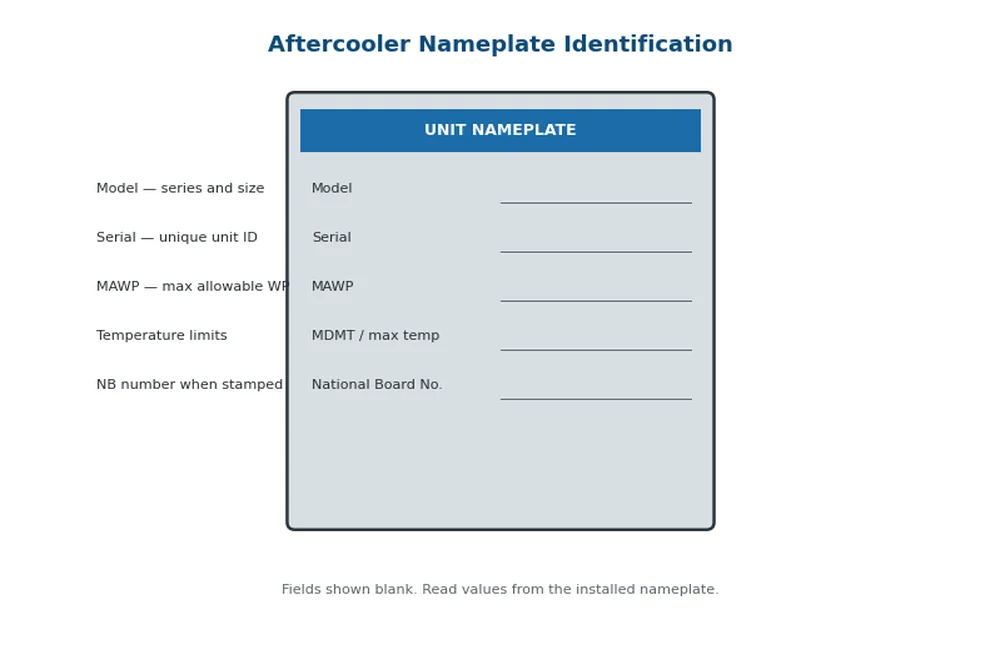
Where a unit is being replaced, the nameplate does most of the work.
- IPAC or HiROSS model number, exactly as stamped
- National Board number where one is fitted
- Connection sizes and orientation