
1-805-484-2992
Quotes - Engineering - SalesSelection Support
Engineering
and Selection
Nine short notes, written for the person who has to pick a unit or replace one.
Start with the section that matches the question - or call 1-805-484-2992 and ask; most selections take one phone call.
Nine notes on sizing, construction and codes, plus the identification pages for reading a nameplate. Most selections take one phone call.
Request a Quote


Engineering
Three Sets of Notes
1.
Selection
The Selection notes cover the three questions we are asked most: how big an aftercooler, whether the 51 or the 59 Series approach is the one to pay for, and how to size a separator that will still work when the compressor unloads.
2.
Construction
The Construction notes explain what is inside the vessel - IPAC's helical extended-surface tube, the materials offered for shell, tubes and heads, and the difference between a fixed and a removable bundle when the cooling water is less than clean.
3.
Codes & Ratings
The Codes notes set out what ASME Section VIII U-stamp construction involves, when Canadian CRN and European PED registration apply, and how the 200 and 300 PSIG pressure classes and the 400°F inlet limit are arrived at.
Identifying a Unit
Before any of the engineering, the number on the nameplate has to be read. The Identification pages map HiROSS, long-form and reseller numbers to the current catalogue number, decode every character of an IPAC model number, and index all 104 catalogued models on one page.
Identification Pages
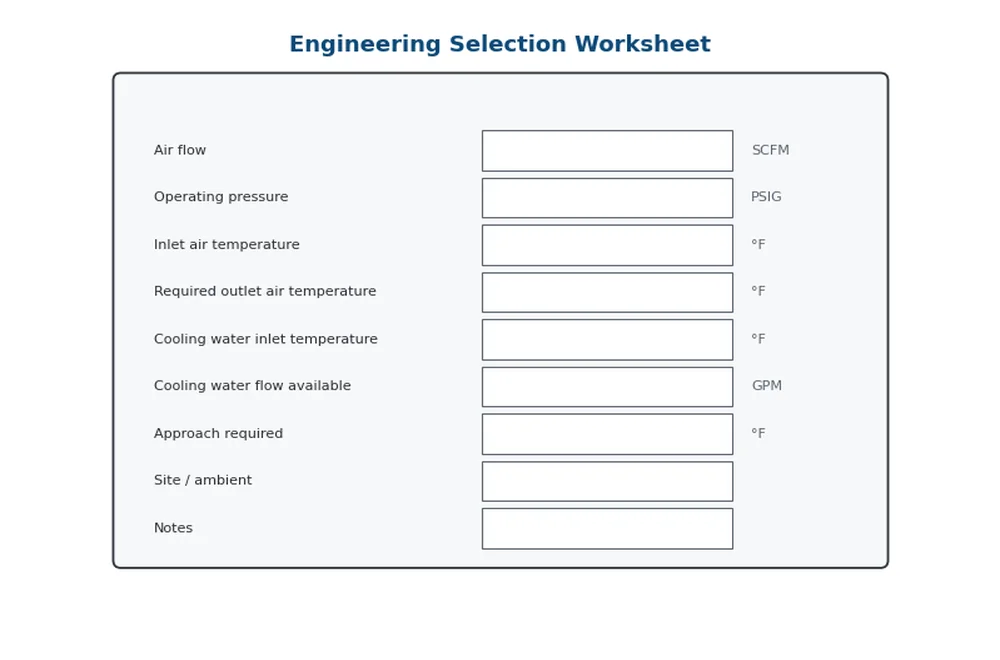
What We Need to Quote
A selection comes together quickly once the duty is stated.
- Compressor SCFM and pressure, or the heat load
- Inlet temperature and the cooling water or ambient temperature
- Required outlet temperature
- Design pressure and any code stamp
Replacing an Existing Unit
Where a unit is being replaced, the nameplate does most of the work.
- IPAC or HiROSS model number, exactly as stamped
- National Board number where one is fitted
- Connection sizes and orientation